Choosing the best Gardening Drill from China requires more than comparing prices or counting accessories. A drill may look powerful in a product photograph, yet struggle in compact soil. Another may perform well on wooden planters but feel heavy after twenty minutes. Battery capacity, torque control, chuck quality, water resistance, and after-sales support deserve closer attention.
Guy Barter, a horticultural adviser associated with the Royal Horticultural Society, offers a practical principle: “Choose the right tool for the job.” That advice fits Gardening Drill selection perfectly. A compact cordless model may suit raised beds, balcony planters, and light-duty hole making. A higher-torque drill may be better for thick timber, greenhouse frames, or stubborn ground anchors. Safety still matters. Buyers should check charging protection, battery certification, insulation, and clear operating instructions.
This guide compares Chinese Gardening Drill options through real working needs, not marketing claims alone. It considers grip comfort, clutch accuracy, runtime, noise, repair access, and performance in damp outdoor conditions. Factory quality can vary. Some products are excellent; others disappoint quickly. I admit that no single model wins every test, especially when users have different gardens, budgets, and strength levels. A cheaper drill can become expensive after a failed battery or missing replacement parts.
The strongest choice is usually balanced rather than flashy. Look for dependable torque, manageable weight, honest specifications, and responsive warranty service. A drill should help the gardener work carefully, not create another problem beside the flower bed.
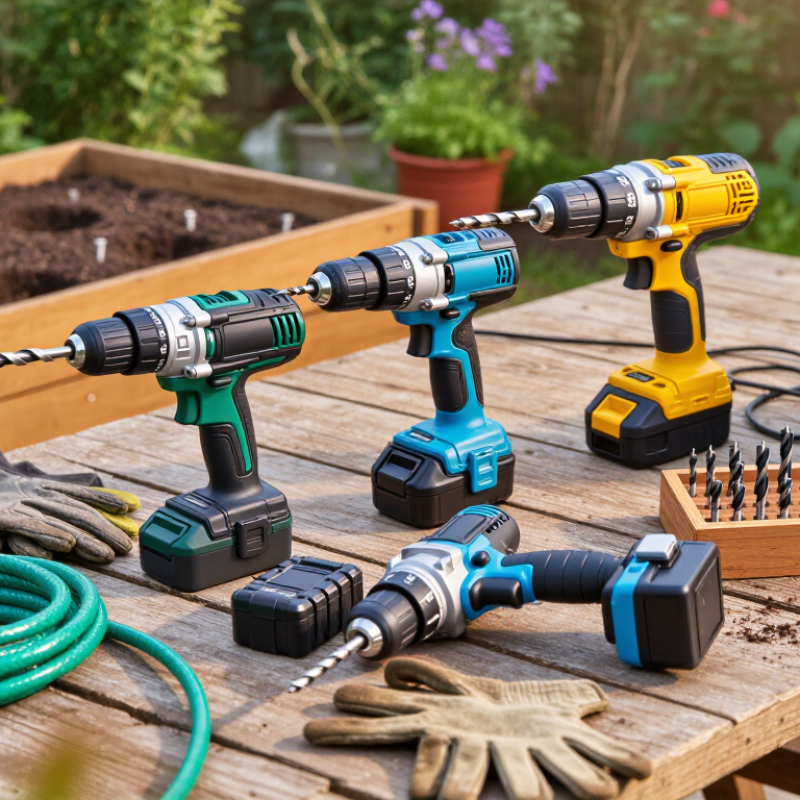
A gardening drill is a compact power tool designed for outdoor planting and maintenance. It can bore holes for seedlings, mix light soil, loosen compacted beds, or drive screws into raised garden frames. Compared with a standard household drill, it should handle soil, moisture, and frequent changes in attachments. A useful model normally offers adjustable speed, steady torque, a comfortable grip, and a battery that lasts through several planting tasks.
China is a practical source for gardening drills because its manufacturing network supports many motor, battery, and tool-component suppliers. This can create competitive prices and flexible specifications. In my experience, the best results come from checking measurable details rather than relying on attractive packaging. Examine the chuck size, torque range, battery capacity, charging time, and waterproofing guidance. Ask for test records, user instructions, and quality-control information. These details show whether the supplier understands real garden conditions.
Look beyond price. A low-cost drill may save money initially but develop battery problems or unstable torque later. That matters. I would also test the balance with an auger attached, since a front-heavy tool quickly strains the wrist. China-made tools are not automatically equal. Some are excellent, while others need better seals, clearer manuals, or longer field testing. A reliable choice should include consistent safety features, replaceable accessories, traceable production information, and responsive after-sales support. Mud changes everything.
| Gardening Drill Type | Typical Power Configuration | Typical Speed Range | Typical Chuck Capacity | Best Gardening Uses | Main Advantages | Important Considerations |
|---|---|---|---|---|---|---|
| Compact Cordless Drill | 12 V to 18 V rechargeable battery | Approximately 0–1,500 rpm | Usually 10 mm | Planting holes, seed trays, raised beds, light pruning-tool maintenance | Lightweight, portable, easy to control in confined spaces | Limited runtime and torque compared with larger models |
| 18 V Cordless Drill Driver | 18 V lithium-ion battery | Approximately 0–1,800 rpm | Usually 10 mm or 13 mm | Wooden garden structures, fence panels, planter boxes, greenhouse frames | Good balance of power, portability, and battery availability | Battery packs add weight and require suitable charging equipment |
| Hammer Drill | Corded electric or high-voltage cordless system | Approximately 0–3,000 rpm, with impact action | Usually 10 mm to 13 mm | Masonry walls, concrete posts, brickwork, hard landscaping | Suitable for drilling hard mineral materials | Heavier, noisier, and generally unnecessary for ordinary soil or wood |
| Right-Angle Drill | Typically 12 V to 18 V cordless power | Approximately 0–1,400 rpm | Usually 10 mm | Tight spaces beneath benches, inside cabinets, and around greenhouse framing | Improves access where a standard drill cannot fit easily | Less versatile for general drilling and may have lower maximum torque |
| Earth Auger Drill | High-torque cordless battery or petrol engine | Often approximately 100–400 rpm | Uses dedicated auger bits rather than a standard chuck | Fence-post holes, bulb planting, tree planting, and soil cultivation | Fast soil penetration and reduced manual digging effort | Requires careful handling; performance decreases in rocky or compacted ground |
| Electric Soil Drill | Rechargeable battery, commonly 18 V to 40 V systems | Usually lower-speed, high-torque operation | Dedicated planting or auger attachments | Repeated planting, nursery work, and soft-to-medium soil | Lower local emissions and generally less noise than petrol equipment | Battery capacity, charging time, and soil conditions affect productivity |
A lightweight cordless drill usually works well for soft beds and small seedlings. A small bulb planter attachment offers better control. Speed is not everything.
Choose higher torque and a slower gear for dense or clay-heavy ground. A useful general range is 30–60 Nm. Larger augers may need more power.
No. Lower-voltage tools can feel lighter around raised beds. Higher-voltage tools may open dense soil more easily. Check torque, weight, and battery heat together.
A 10-millimeter chuck suits smaller planting bits and light attachments. A 13-millimeter chuck supports heavier attachments. Confirm the attachment size before purchasing.
A 2.0 Ah battery keeps the tool lighter for short tasks.
Look for rubber grips, balanced weight, and a lockable trigger. Wet gloves can make a heavy drill unsafe. Grip shape matters.
Request rated torque, no-load speed, battery-cell details, and warranty terms. Ask for safety records and inspection reports. Test samples in real soil.
Compare torque figures using the same testing method. Check performance on compacted soil, not only on a smooth display board. I once trusted impressive power and ignored weight. That was poor judgment.
A Gardening Drill is a practical tool designed for tasks such as planting bulbs, preparing soil, mixing garden materials, and installing small supports. Choosing a model from China can offer a broad range of options, specifications, and price levels, but the best choice should be based on performance and reliability rather than origin alone. Buyers should consider motor power, battery capacity, torque, speed control, chuck size, weight, balance, and compatibility with different gardening accessories.
When comparing Chinese gardening drills, it is important to match the tool type and specifications with the intended workload. Lightweight cordless models may suit routine home gardening, while stronger designs are better for dense soil or frequent use. Buyers should also check electrical safety features, battery protection, durable construction, user instructions, and quality-control certifications applicable to their market. Regular cleaning, proper charging, secure storage, and timely inspection can extend service life. Ultimately, the right Gardening Drill should be comfortable, safe, versatile, and appropriately powerful for the garden tasks it will perform.

 SINOVO